


An International Publications House
Albert Science International Organization
Connecting People With Pioneering Thought


JOURNALS || Health & Medicine Blog (ASIO)
 Cardiopulmonary Resuscitation (CPR): A Life Saving Process
Author Names : Asmit Sarkar
Cardiopulmonary Resuscitation (CPR): A Life Saving Process
Author Names : Asmit Sarkar Page No. : 01
Read Hit : 157
Pdf Downloads Hit : 6 Volume 4 Issue 1
Cardiopulmonary Resuscitation (CPR): A Life Saving Process
Asmit Sarkar, UG student, BCDA College of Pharmacy & Technology,
Hridaypur, Barasat, Kolkata-700127, asmitsarkar340@gmail.com
CPR:
A life saving process everyone should know Cardiopulmonary Resuscitation (CPR) is a critical emergency procedure that can save lives when someone's breathing or heartbeat has stopped. Situations like sudden cardiac arrest, drowning, electric shock, or choking can lead to such emergencies. Immediate action through CPR helps maintain blood flow to the brain and vital organs until professional medical help arrives. According to organizations like the World Health Organization and the American Heart Association, timely CPR can significantly increase survival rates. Brain damage can begin within 4-6 minutes without oxygen, making quick response essential. Steps of CPR involve a combination of chest compressions and rescue breaths.
The process can be summarized in three main steps [Figure 1]:
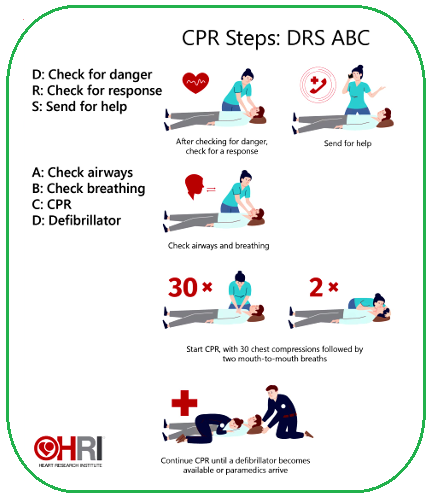
1. Check Responsiveness and Call for Help First, check if the person is conscious by tapping and shouting. If there is no response, call emergency services immediately or ask someone nearby to do so.
2. Chest Compressions Place the heel of one hand in the center of the chest, place your other hand on top, and press down hard and fast. Compress the chest at least 2 inches deep at a rate of 100-120 compressions per minute. This helps circulate blood to vital organs.
3. Rescue Breaths after 30 compressions, give 2 rescue breaths. Tilt the head back, lift the chin, pinch the nose, and breathe into the person's mouth until the chest rises. Continue the cycle of 30 compressions and 2 breaths. For people who are not trained or unsure, "hands-only CPR" (continuous chest compressions without breaths) is recommended and still highly effective.
1. World Health Organization -Emergency care guidelines and first aid recommendations
2. American Heart Association - CPR and ECC Guidelines 3. Red Cross First Aid/CPR/AED Participant Manual
3. https://www.who.int/heath-topics/emergency-care#tab-tab_1
4. https://cpr.heart.org/enfresuscitation-science/cpr-and-ecc-guidelines
5.https:l/www.redcross.org/store/first-aid-cpr-aed-participants-manual/754100.html ?srsltid=AfmBOoq88NVjpyzjGxFgzhikeg43CfqWwBiP_3W_4jskOPp091mTERGY